Proteins from the Pfam CPA_AT clan (Monovalent cation/proton antiporter/Anion transporter) transport a variety of ions, amino acids and other charged compounds. Due to their functional importance, CPA/AT transporters are ubiquitously present in all three kingdoms of life.
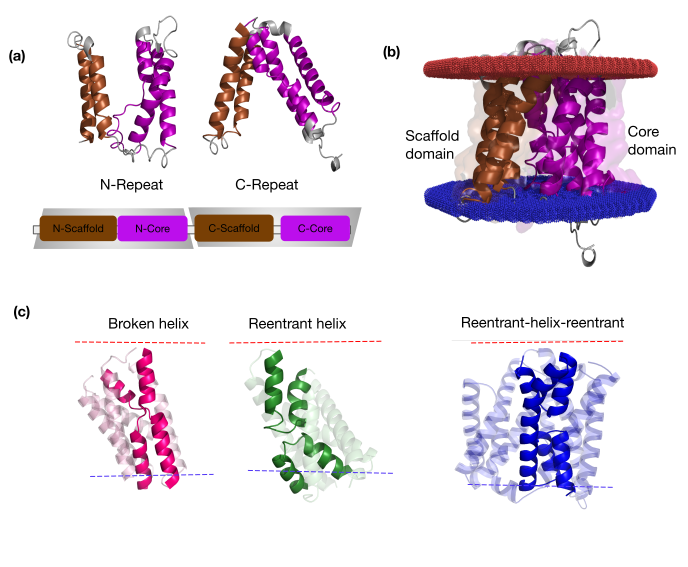
The figure shows the sodium bile acid symporter (PDB id:4n7w). CPA/AT transporters generally consists of two structurally and evolutionarily related inverted repeat units, each of them with one core and one scaffold subdomain. The repeats are shaded in grey. In structure space, the N-terminal scaffold and C-terminal scaffold subdomain come together to form the scaffold domain. Similarly, the N- and C-terminal core subdomains come together to form the core domain. The lipid bilayer is coloured red and blue to denote outside and inside respectively. Scaffold subdomains can have varying number of helices. Central to the function of the transporters is the existence of non-canonical helices that are involved in the transport process. The core domain can have broken (Coloured in dark pink) or reentrant (Coloured in green) non-canonical helices. The third type of non-canonical helix has been identified for the first time in this work using ab initio modelling is named the “Reentrant-Helix-Reentrant” (Coloured in blue).